
Confirming the Finish Before Production
Surface finishing determines how a tile looks and feels after the applicable firing and processing stages. For importers, distributors and project buyers, the requirement should identify the finish, tile body, dimensions and intended application together.
We review whether your selected range is available with the requested surface or needs further sample evaluation. A polished appearance cannot be added to every tile without considering its construction. Ceramic wall tiles, glazed porcelain tiles and unglazed porcelain tiles may require different finishing routes.
The approved reference should define the expected sheen and texture before production scheduling.
Matching the Finishing Route to the Tile
Mechanical polishing uses abrasive processing to refine a suitable fired surface. Depending on the product, this may involve an unglazed porcelain body or a glaze designed for polishing. These constructions should not be treated as equivalent.
Matt and textured finishes are not necessarily produced by polishing. Their appearance may come primarily from the glaze, forming texture or other product-specific processing.
Our surface finishes and glazing options page helps establish which finish to discuss. A request to change an existing surface requires feasibility confirmation rather than an assumption that all finishes are interchangeable.
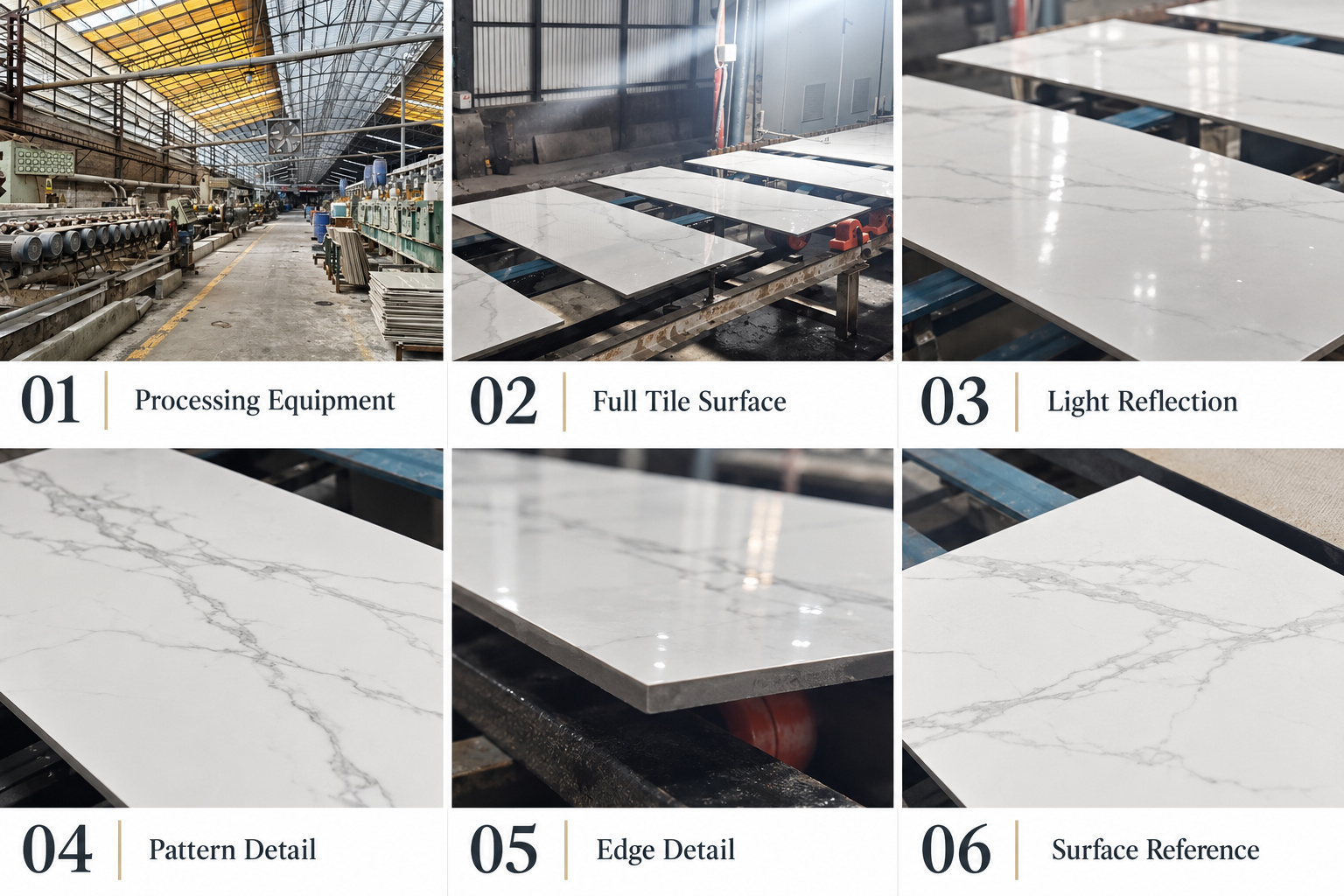 Controlling Surface Appearance During Processing
A finishing sequence must suit the surface being processed. Abrasive selection, material removal and processing consistency affect the final appearance. Excessive or uneven removal can alter a suitable glaze layer or create visible differences across the face.
Surface review considers uneven gloss, scratches, dull areas and unwanted processing marks. Residue also needs to be removed so that the actual surface can be assessed.
For patterned tiles, buyers should review how reflections interact with the design. A close-up photograph may show print detail while concealing a broader difference in sheen across the tile.
Reviewing Edges and Finished Dimensions
Surface polishing and edge rectification are separate operations. A polished tile should not automatically be described as rectified, and a rectified tile does not necessarily have a polished face.
Where edge processing applies, the final dimensions, squareness, bevel and edge condition need to match the agreed specification. Review these details alongside tile sizes and thickness options, especially when coordinating several formats within one project.
Edge chips and corner damage should be considered during finished product inspection and packing preparation.
Approving Samples Under Consistent Lighting
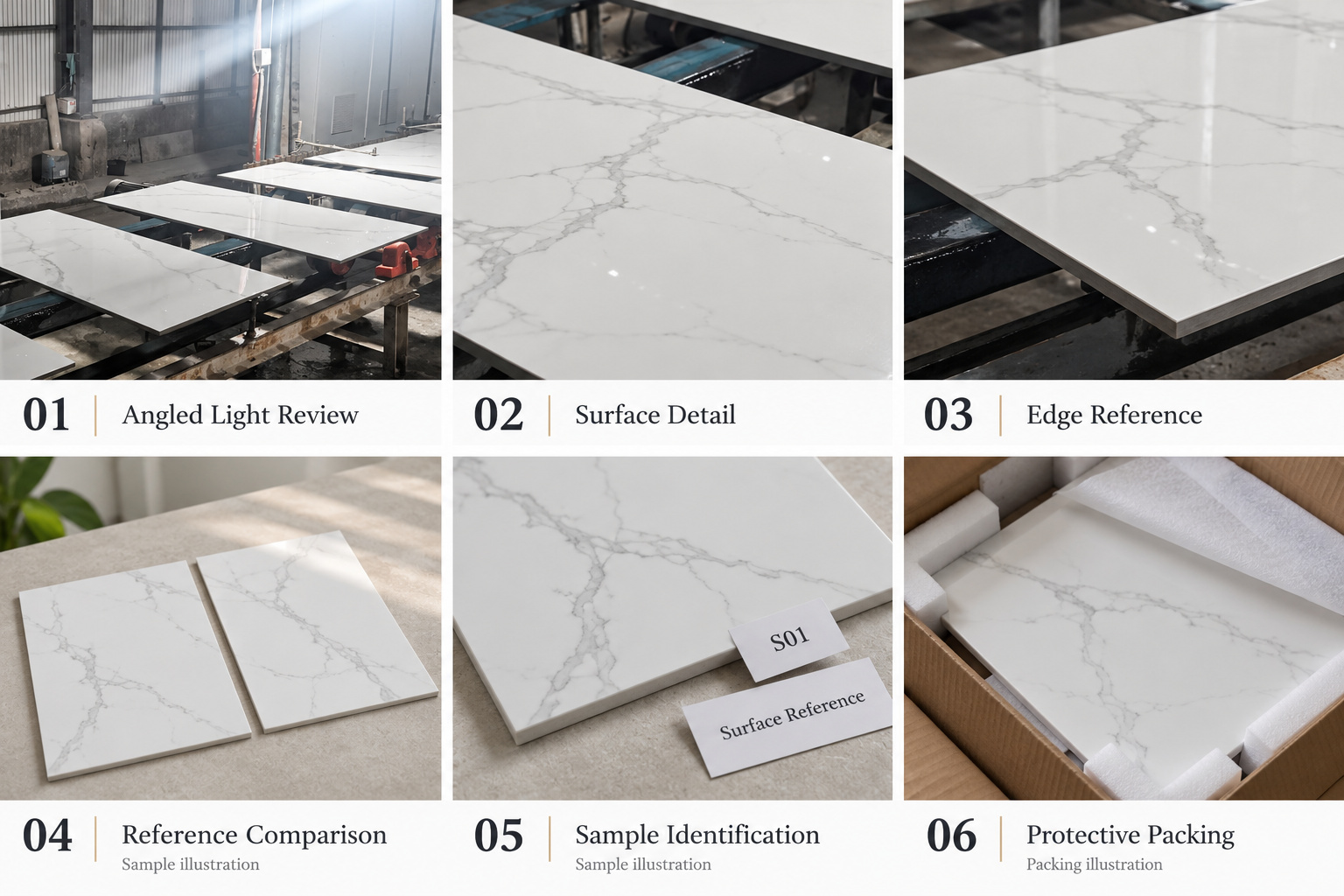
Review the selected finish on a physical sample under consistent lighting, including an angled view that reveals reflection and texture. For larger formats, a full-size sample provides a more useful view of overall appearance than a small cut piece.
Terms such as soft gloss, satin and semi-polished can be interpreted differently. Record the accepted sample identification and finish description through sample development and approval.
Gloss alone does not establish slip resistance, stain resistance or suitability for a particular installation. Any required performance needs separate product-specific confirmation.
 Confirming Packing and Order Requirements
Protective packing should suit the finished surface, tile format and handling requirements. Appropriate separation and edge protection help reduce contact damage during packing and transport.
Send the tile category, dimensions, desired finish, quantity, destination market and reference sample where available. Include any edge requirements or mandatory performance criteria.
We can then review finish availability, sample arrangements, MOQ and production lead time, followed by carton quantities, protective packaging and shipment requirements.